Steven Barlow writes: Coldstream is a
Scottish border town north of the Cheviot Hills and Kerr and Black used this name
for their estate in the 1850s.
However, the suburban Cheviot Park Estate in Coldstream may only date
from the early 1960s as the local football side is recorded as having moved
there in April 1961 [“More Club History. Coldstream Over the Years”] and, in
the recent debate on dual occupancy in the area, one media correspondent writes
that it is only about 30 years old. It does not appear on the 1935 topographic
map. Certainly the housing on the estate seems to date from the 1960s and
1970s. The other name for the district, “The Lodge” is reflected in the nearby
shopping centre.
A Mr McFadzean is
reported to have to have been a benefactor of the football club. One William
Frederick McFazdean was a VC recipient from the First World War and is a name
repeatedly used by Saxil Tuxen and may have also a connection with the
Merrilands and Broadmeadows estates by that surveyor.
The design of the
street pattern, with its internal reserves and insistent geometry however,
seems to indicate it was a product of the garden city phase of town planning
from the 1920s, with affinities to other estates such as at Albion, North
Altona and Yallourn.
The estate is designed
on a radial pattern, with bent spokes centred on the hub of a large park,
Halley Supple Reserve, set behind a small row of shops. These shops are
reported in the local media to be in a state of decline. The hexagonal hub of
the half cartwheel is close to the highway. The paired entrance roads are termed the East and West
Gateways, names that appear in Walter Burley Griffin’s Milleara plan of 1927.
The entrance is also flanked by two segments of stone wall - probably of recent origin and very
much in the manner of typical new estate entrances. The central park is largely given over to sport, with an
oval, tennis courts, clubhouse, toilets, etc. Some large trees have been retained on the park boundary,
but the whole is still dominated rather unfortunately by a chain mesh fence.
The streets are bent,
rather than curved, which is typical of Tuxen estates (such as Eastern Gardens
in North Balwyn) and differ from Griffin’s use of smooth curves and an
asymmetrical plan, such as at Heidelberg and Mt Eliza.
Three internal
reserves are provided. One (unnamed) has access ways from adjoining streets
while the others are cul-de-sacs. In all cases the reserves appear, upon
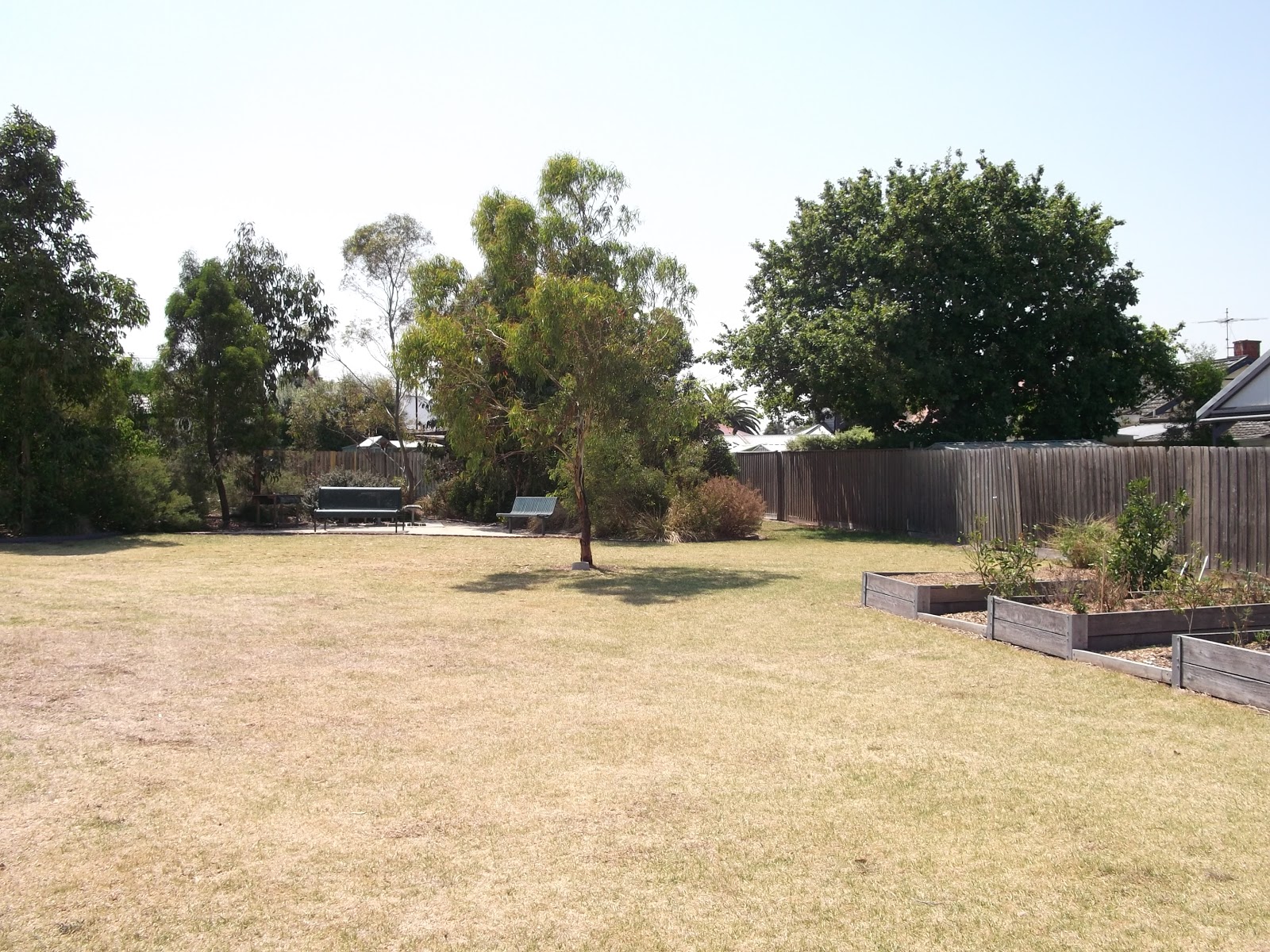
cursory inspection, to be little used and appreciated. There are no pathways
provided and a seat is provided in only one. There is no play equipment or community garden. There is
very little retained or replanted vegetation and few large trees. There is no
shrubbery understorey. The rough
grass was mown short and some large trees had been recently felled. Every house abutting the reserves had
high paling fences and there was no attempt to either disguise the fence lines
with shrubbery or to have any linkage between private gardens and
reserves. However, the reserves
were tidy and with no evidence of their use for vehicular access, storage or
rubbish disposal.
Two pathways which
seem to have been added to the estate to connect to Lauriston Drive, by
comparison, seem to be carefully landscaped with vegetation and paving.
Most of the houses did
not show much evidence of their occupants’ interest in gardening, although most
were neat. There were few large trees in private gardens (considering the high
rainfall in the area) and much evidence that residents and the Shire had
striven to remove large trees, perhaps for fear of fire or falling limbs. Many
front gardens were given over to parking for residents’ cars, caravans and
trailers, although the blocks were not unusually small. Clearly most residents are not well to
do but the possession of multiple vehicles is either considered desirable or a
necessity in an area with limited public transport – only an infrequent bus
services being available.
Of the three internal
reserves, only Glenhurst Park could be considered to be attractive, although it
did not show signs of being utilised any more than the others. This reserve has
a line of old Cyprus pines, which may have predated the estate or possibly have
been planted with it. Several of
these had been felled and so only a couple remain. Where some taller trees and shrubbery threatened to mask the
boundary fences in one portion, the vegetation has been cut back two or three
metres. Clearly the Shire or the
residents felt that vegetation touching the fences was undesirable. This may be due to a belief in the need
to access the fences from both sides for maintenance, fear of bushfire or fear
of lurking places for undesirables. This reserve was not fully enclosed by
residential blocks and afforded views on the north side to farmland.
The need for internal
reserves in this estate may be questionable. In a rural area such as Coldstream there is no shortage of open
land for spiritual refreshment, unlike in inner urban areas. Also, unlike in the inner suburbs, the
private blocks are not mean and so there is ample private land for growing
vegetables and for children’s games.
The nearby Halley Supple Reserve provides for sporting activity and
Margaret Lewis Reserve, on the southern boundary and abutting the Primary
School, seems to be of a size and configuration more suitable for residents’
recreational needs, unlike the internal reserves, which are too small and fragmented
for multiple uses.
Further study may
reveal that typical internal reserves, with their small individual acreages and
sequestered locations, are less successful than larger parks with high public
visibility. Residents may actually be fearful of these small, enclosed spaces
adjacent to their homes, despite the obvious advantages in safety from traffic
and the possibility of intercommunication between neighbours, as pointed out by
proponents such as Griffin. Thus the optimal size of reserves for their
economical maintenance and for the provision of multiple sporting and
recreational uses in them, including the provision of barbecues and toilets,
may be greater than that of typical internal reserves. This may be all the more important
where it is left to the municipality (such as the Shire of Yarra Ranges in this
case) to maintain them and where local residents do not have the income or
desire to collectively maintain them under a covenant, as Griffin had hoped.
The limited success of the internal reserves even at Heidelberg, where the
residents are of a higher socio-economic status than those at Coldstream,
Avondale Heights and Merrilands, points to this as a likely problem.
The local residents
may not have the income or the free time to undertake community initiatives,
such as re-vegetating the reserves behind their houses nor see them as a
priority. In rural areas, the
struggle to keep land around the houses safe from bushfire is perhaps more
important than the need to soften the urban-rural interface or to provide
pockets of recreated natural landscape for starved city dwellers.